Note: The scope of robots in this article includes: lawn mowing robots, humanoid/quadruped robots, mobile robots (AGV/AMR) and commercial service robots, and other categories of robots are not included.
01 Industry Overview
Compared with vision sensors (such as depth cameras), lidar emits lasers to measure the accurate distance between objects and sensors, which has the advantages of accurate measurement, long measurement distance, fusion of multiple sensors, less affected by light environmental factors, and the ability to generate environmental maps for easy navigation.
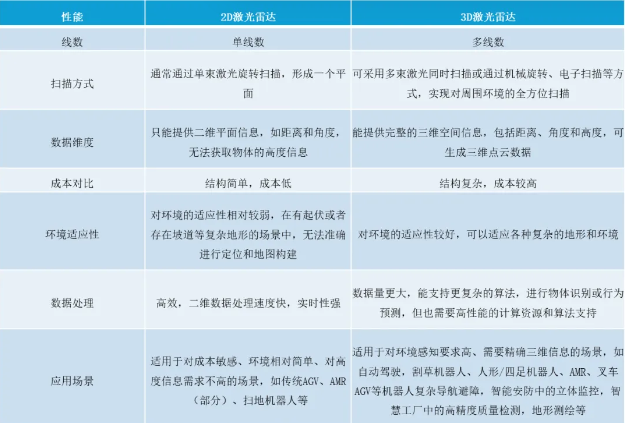
According to the classification of transmitted wiring harnesses, LiDAR can be divided into single-line LiDAR and multi-line LiDAR. Among them, single-line lidar has only one laser transmitter and receiver, which can only perform planar scanning, cannot measure the height of the object, and obtain 2D point cloud data, so it is also known as 2D lidar, which has the advantages of fast scanning speed, strong resolution, high reliability and low cost, and is suitable for robots operating in closed environments, such as traditional AGVs, sweeping robots, etc.
Multi-line lidar, or 3D lidar, emits and receives multiple lasers at the same time, which can scan the environment from different angles and heights to form 3D point cloud data including height (z-axis). Compared with 2D lidar, 3D lidar has a complex structure, high resolution, high cost, suitable for complex environments, has become a key sensor in the field of intelligent driving, and benefits from the scale effect of in-vehicle applications, the price of 3D lidar continues to fall, and is accelerating its application to the robot market.
Figure 1 Comparison of 2D and 3D LiDAR performance
Source: Gaogong Robot Industry Research Institute (GGII)
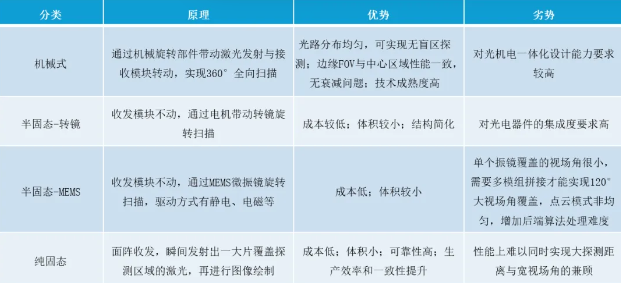
According to the classification of moving parts, lidar can be divided into mechanical, semi-solid-state, and all-solid-state lidar. The mechanical lidar transceiver array follows the motor to rotate, has a large field of view, and has high technical maturity, but it requires high opto-mechatronics design capabilities. Semi-solid-state LiDAR only has some moving devices, such as rotating mirrors, MEMS galvanometers, etc., with a small horizontal field of view, but reduced mechanical components, low mass production costs, and a balance between performance and price, which is the current mainstream automotive forward sensing lidar technology solution; All-solid-state lidar has no moving parts inside, controls the direction of the beam through electronic signals, including optical phased arrays (OPA and Flash technology solutions), the volume can be as small as the size of a coin, and the price can be lower under the premise of large-scale production, and is currently mainly used in close blindness.
Figure 2 Comparison of LiDAR scanning methods
Source: Gaogong Robot Industry Research Institute (GGII)
The technical capabilities of automotive 3D lidar are migrating to the field of robotics. During this period, leading players such as Hesai and Suteng Juchuang have carried out domestic substitution and integration of domestic substitution and integration of discrete components, optical chips and supporting components through self-developed SoC chips, significantly reducing production costs and accelerating production capacity expansion, promoting the evolution of product forms from discrete to integrated, achieving exponential cost reduction, and laying the foundation for 3D lidar to enter the field of robotics.
In the field of robotics, the scale of intelligent lawn mowing robots, the accelerated mass production of humanoid robots, the rising demand for quadruped robots, and the accelerated replacement of traditional mobile and commercial robots with 2D lidar have become the main driving forces for the growth of the 3D lidar market. In the future, with the further decline in large-scale costs, the penetration rate of 3D lidar in the robot market will further increase.
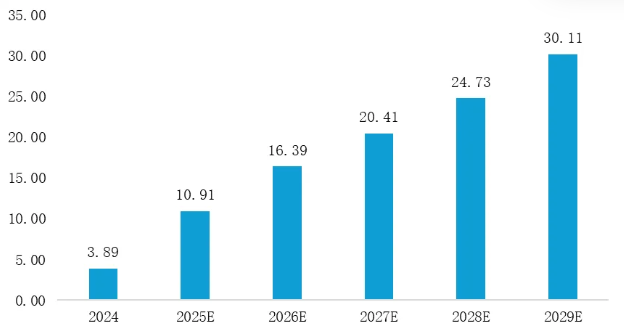
From the perspective of market size, GGII data shows that the global 3D lidar market size in the field of robots (including lawn mowing robots, humanoid/quadruped robots, mobile robots and commercial service robots) in 2024 will be 389 million yuan. In 2025, driven by the lawn mowing robot and mobile robot markets, the market size of 3D lidar is expected to double to 1.091 billion yuan, and the market size will exceed 3 billion yuan by 2029, with a compound growth rate of about 28.89% from 2025 to 2029.
Figure 3 Global 3D LiDAR market size and forecast in the field of robotics from 2024 to 2029 (unit: 100 million yuan)
Source: Gaogong Robot Industry Research Institute (GGII)
02 Application analysis
In the emerging lawn mowing robot market, the integration solution of "3D LiDAR Vision" is replacing the mainstream "RTK Vision" solution and entering a virtuous circle of "3D LiDAR to improve product strength - promote the expansion of market size - reduce 3D LiDAR costs - further improve the loading rate". With the high-precision environmental perception capabilities of 3D lidar, the lawn mowing robot can scan the terrain of the courtyard in real time, accurately identify obstacles, boundaries and vegetation distribution, and achieve efficient and accurate mowing path planning.
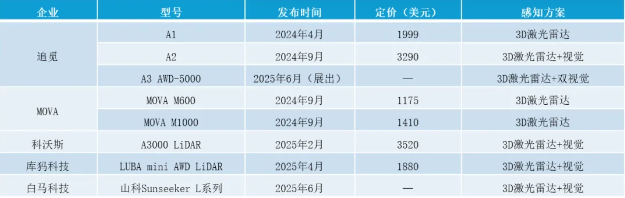
In April 2024, Keting Technology, a subsidiary of Dreame Technology, launched the first borderless intelligent lawn mowing robot A1 equipped with 3D lidar, opening up a new track of "unbounded intelligent courtyard", with shipments exceeding 100,000 units in less than a year. Equipped with Hesai JT16, the lawn mowing robots MOVA 600 and MOVA 1000 can be turned on to quickly complete three-dimensional mapping, and third-party measurements show that it only takes 3.5 minutes to map a 1,000-square-meter area, which saves 80% of deployment time compared with the traditional RTK solution, and does not require manual thread embedding, easy installation, and the shipment volume has exceeded 100,000 units in less than half a year, topping the sales list of the German and French Amazon smart lawn mowing category.
The popularity of 3D LiDAR lawn mower robots has ignited market enthusiasm, and Ecovacs, Kulu Technology, Sunseeker, etc. have launched "3D LiDAR Vision" lawn mowing robot products. After further cost reduction in large-scale applications, the 3D LiDAR fusion solution is expected to further replace the "RTK/UWB vision" solution. With its technological leadership, mass production delivery capabilities and brand influence in the field of lidar, Hesai Technology has become a leader in the lidar market in the field of lawn mower robots, and will provide 300,000 JT series lidar for Dreame lawn mower robots in the next year.
Figure 4 LiDAR solution products of lawn mowing robots
Source: Public information, Gaogong Robot Industry Research Institute (GGII)
The combination of the physical environment in which humanoids and quadruped robots are located is more complex and changeable, and an accurate and reliable perception system is crucial, and the fusion scheme of "LiDAR depth camera" has become the mainstream in China. The humanoid robots of Yushu Technology, Zhiyuan, and Magic Atom are all equipped with 1 3D lidar, and Yushu Technology's robot dog is equipped with Hesai Technology's XT series lidar. However, unlike the large-scale cost reduction path of vehicle-mounted lidar, the humanoid robot market is relatively fragmented, and the application scenarios cover many complex environments such as homes, industries, shopping malls, etc., with high demand for customization, and the cost of lidar in it is low, and the urgency of price reduction is relatively mild, or the future profit area of 3D lidar.
In the field of traditional mobile and commercial robots, 2D lidar is still the main focus in China, and the penetration rate of 3D lidar of overseas models is relatively high. With the development of technology and the reduction of costs, 3D LiDAR will accelerate the replacement of 2D LiDAR with its significant advantages in improving operational efficiency and safety. 3D LiDAR can generate high-precision 3D point cloud maps to achieve more accurate environmental modeling and real-time data processing, thereby helping robots navigate more efficiently, avoid obstacles, and plan paths in complex environments.
At present, the demand for 3D LiDAR for navigation obstacle avoidance and transportation applications of AMR and forklift AGV is relatively clear. The BR-F15P pallet unmanned forklift is equipped with 3D lidar and depth vision camera, which can identify suspended obstacles in the air; Based on 3D laser sensor technology, Yunxiang Robot can achieve highly reliable positioning and navigation in complex factory environments, avoiding the problem of lost positioning. Hesai Technology's JT series and XT series lidars have provided more reliable positioning, navigation, and obstacle avoidance support for mobile robots such as Xinsong and Jiuyao through high-precision 360° environmental perception capabilities.
03 Competitive landscape
Based on the statistics of the total shipment volume of 3D lidar companies in the Chinese market in the first half of 2025 and the combing and research of shipments in various segments and scenarios, combined with public data and interviews with industry experts, GGII released the list of "3D LiDAR Shipment Ranking in the Field of Robotics in the First Half of 2025".
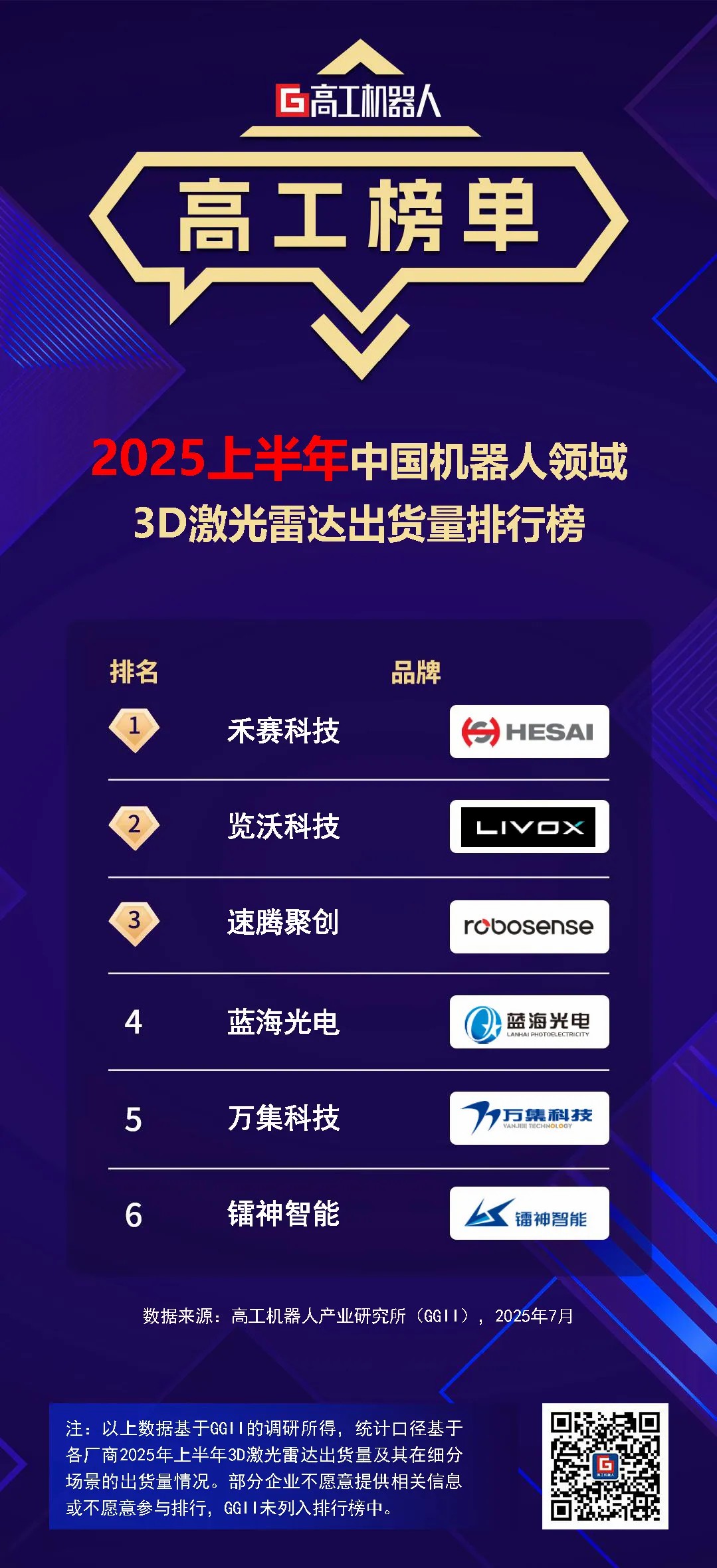
Source: Gaogong Robot Industry Research Institute (GGII), July 2025
Note: The above data is based on GGII's survey, and the statistical caliber is based on the 3D lidar shipments of each manufacturer in the first half of 2025 and their shipments in subdivided scenarios. Some companies are unwilling to provide relevant information or participate in the ranking, and GGII is not included in the ranking.
Hesai Technology, the founding team was established in Silicon Valley in the United States in 2013 and moved to Shanghai in 2014, building a complete lidar product matrix covering automotive, robotic, industrial and other fields through the platform strategy, realizing full-stack technology reuse and large-scale expansion, and becoming the core of the platform with the fourth-generation self-developed chip architecture, deriving major product lines through modular design, forming a technical ecology of "chip homology and scene adaptation". In May 2025, the delivery volume of lidar will exceed 100,000 units, becoming the first lidar company in the world to achieve a monthly delivery volume of more than 100,000 units. In the next year, Hesai will provide 300,000 JT series lidars for Keting Technology. At the same time, the JT series covers a wide range of fields such as mobile robots, distribution robots, cleaning robots, and lawn mowing robots. The company has served more than 2,000 customers, covering more than 40 countries around the world.
Livox, founded in 2016, is an independent company based on DJI's internal incubation mechanism, committed to the development of 3D LiDAR technology, focusing on the industrial field, since the launch of the Mid series of products in January 2019, Livox has served more than 1,500 customers, and the products are sold to 26 countries and regions including the United States, Canada, China, Japan and the European Union.
Suteng Juchuang, founded in 2014 and co-founded by a team of teachers and students from Harbin Institute of Technology, is comprehensively laying out the field of robotics. The company held a "Hello Robot" press conference in January 2025, released the strategy of "robot technology platform company", positioned itself as a "provider of incremental components and solutions for intelligent robots", and launched all-solid-state digital lidar E1R and Airy, Active Camera solutions for the field of robotics. As of the first quarter of 2025, the company's cumulative number of customers in industrial warehousing, distribution robots, commercial cleaning, unmanned mining trucks and other subdivisions has exceeded 2,800.
The melee of 3D lidar in the field of robotics has just begun, and it is difficult to say that the pattern has been decided. First, the downstream application market pattern is undetermined, the current penetration rate of intelligent lawn mowing robots in the global lawn mowing market is still low, the humanoid robot market has not yet exploded, and there is enough incremental market to accommodate more brand competition; Second, the penetration rate of 3D lidar solutions is still low, there are no vehicle-level barriers, and latecomers still have opportunities, in addition to Hesai, Lanwo, Suteng Juchuang and other list companies, eyeing this incremental market are also Yijiatong Technology, Tudatong, Liangdao Intelligence, Yijing Technology, etc., Ecovacs' Krypton Technology is also planning and trying 3D lidar technology, and has attracted the attention of some industrial customers.
Similar to automotive lidar, the key to winning the market is to bind more customers. In the field of lawn mower robots, in February, Lanwo Technology reached a strategic cooperation with Keting Technology, and plans to deliver more than one million radars in the next three years; In April, Hesai Technology signed a strategic cooperation agreement with Keting Technology to provide 300,000 JT series lidar in the next year; Suteng Juchuang has obtained exclusive cooperation from two global leading lawn mowing robot customers, including Kuma Technology announced a strategic cooperation in May to deliver 1.2 million all-solid-state lidar units in the next three years; In June, Yijiatong announced that its 150-line all-solid-state lidar has successfully won the project order of the leading lawn mowing robot brand.
In the field of humanoid/quadruped robots, Hesai's XT series is providing 3D perception technology for Unitree Technology's robots and applying them to scenarios such as BMW Automatic Factory Driving System (AFW); Suteng Juchuang has established strategic cooperative relations with more than 10 humanoid robot companies around the world, including Yushu, Shanghai Humanoid Robot Innovation Center and well-known overseas humanoid robot companies.
GGII believes that 3D LiDAR will maintain a high growth trend in the field of robotics in the next few years, and when humanoid robots are released, it will be a sea of stars. In the face of rich scenarios and high customization needs of robots, manufacturers need to provide system solutions that combine coupling technology, scenarios and processes, rather than simply delivering products. Facing the ultimate needs of humanoid robots, 3D LiDAR will evolve in the direction of all-solid-state and miniaturization, high resolution and high precision, multi-sensor collaboration, and deep integration with AI large models.